Artemis II Watches: From Omega X-33 to the MoonSwatch

Mechanical movements and watch engineering
Artemis II didn't just carry astronauts—it carried a microcosm of modern horology. We dissect NASA's certified Omega X-33 Gen 2 instrument, the astronaut's personal Breitling Cosmonaute, and how the MoonSwatch enabled a global community to participate in the historic mission.

The ghost of Gene Cernan’s Omega Speedmaster, strapped over his spacesuit on the lunar surface in 1972, casts a long shadow. For over half a century, the mechanical Moonwatch was the definitive symbol of human spaceflight. But on April 1st, 2026, as the Artemis II crew gazed back at the whole Earth from lunar orbit, their wrists told a different story—a story of digital pragmatism, personal choice, and a surprising, grassroots tribute from a global watch community.
This isn’t just another “watch in space” article. This is a dissection of a paradigm shift. The Artemis II mission didn’t just carry astronauts; it carried a microcosm of modern horology: a NASA-issued multi-function digital instrument, a pilot’s private mechanical marvel, and the echoing cultural phenomenon of an accessible bioceramic homage. Let’s strip away the marketing and examine the engineering and sociology behind the watches of humanity’s return to the Moon.
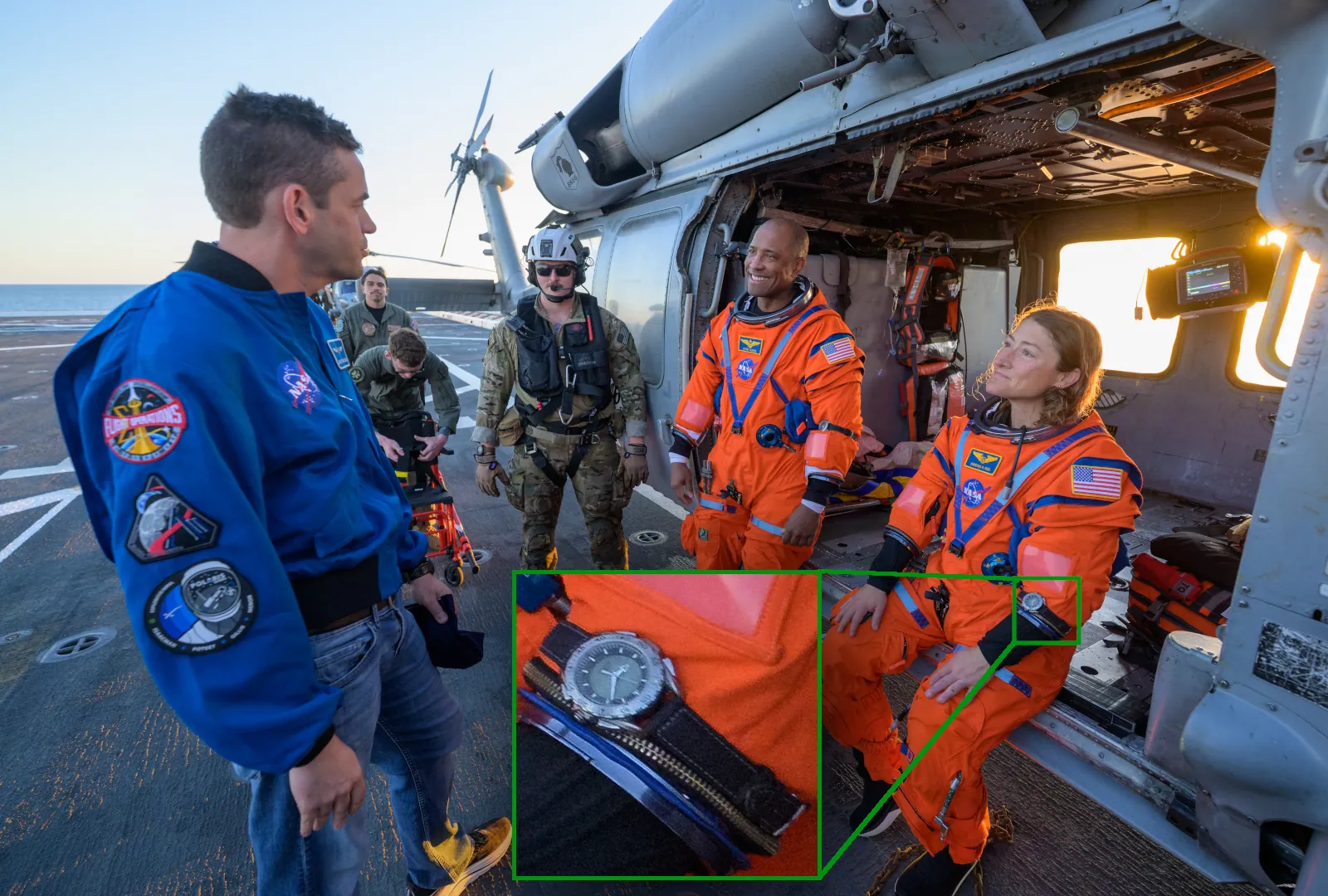
The Deep Dive: Deconstructing NASA's Chosen Instrument - The Omega Speedmaster X-33 Gen 2
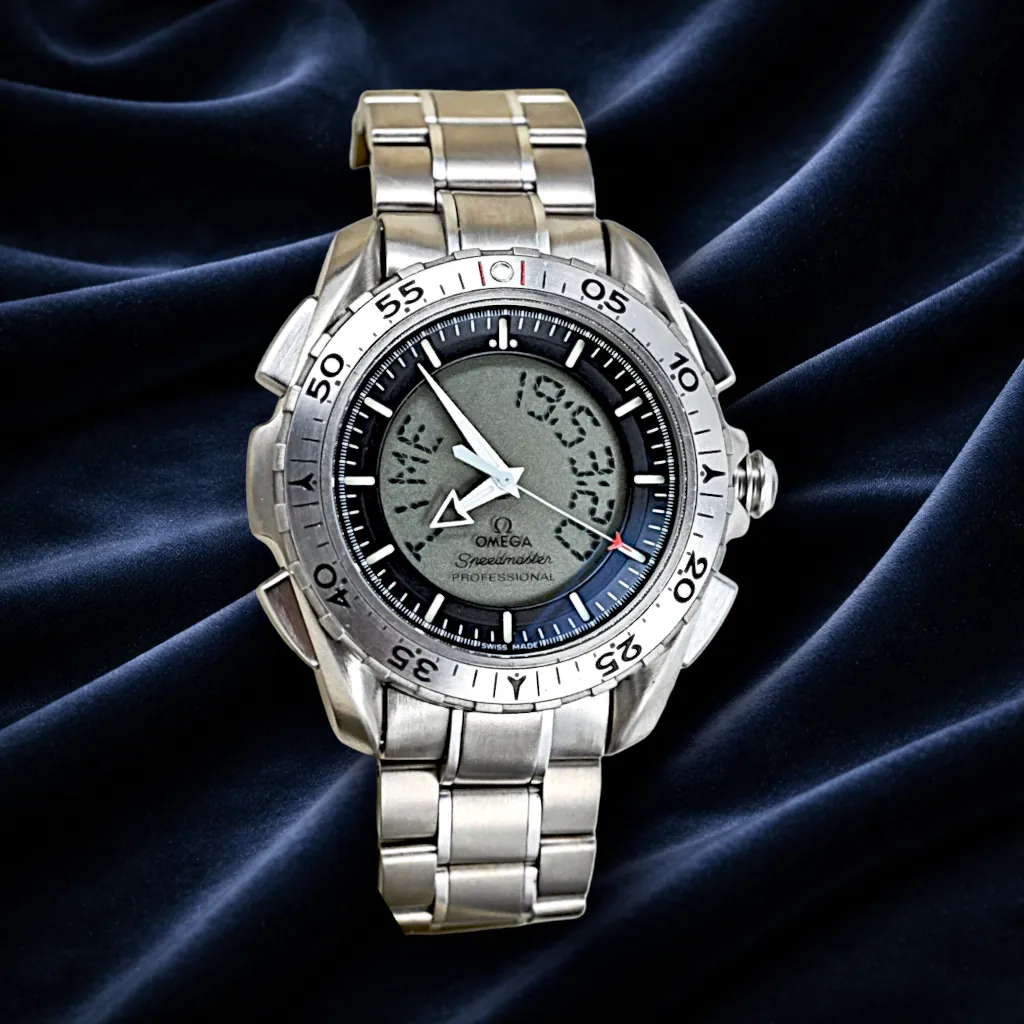
Forget the press releases and surface-level summaries. The choice of the Omega Speedmaster X-33 Gen 2 (Ref. 3291.50.00) for Artemis II is a masterclass in aerospace engineering pragmatism, representing a deliberate step backwards in consumer technology to ensure absolute mission safety. This wasn't about having the latest gear; it was about deploying a perfectly known, flight-qualified instrument.
The Legacy Certification Cliff: Why NASA Uses a "20-Year-Old" Watch
The most critical fact competitors miss is the "legacy certification cliff." NASA's qualification process for crew equipment is brutal, exhaustive, and locked to a specific item's design, down to the component supplier. The Gen 2 X-33, originally qualified in the late 1990s/early 2000s for the Space Shuttle and International Space Station programs, represents a "frozen, known quantity." Every material, solder joint, and chip in that specific reference has been tested against vibration, vacuum, thermal shock, and electromagnetic interference.
Certifying the newer, third-generation X-33 for a crewed lunar mission would be a multi-million dollar, multi-year project requiring destruction testing of multiple units. For NASA, the Gen 2 isn't obsolete; it's operationally perfect. Its software interface is known intimately by astronauts and ground crews. Its failure modes are documented. In aerospace, this is the pinnacle of reliability: a tool that has crossed the certification cliff and become a standard part.
Movement Mechanics: The Intelligence of the Omega Calibre 1666
While many sources simplify this as a standard quartz, the Gen 2 utilizes the Omega Calibre 1666—a highly customized electronic module based on the high-precision ETA 988.431 architecture. This is not a standard off-the-shelf movement; its core is a quartz crystal oscillator whose frequency naturally fluctuates with temperature changes.
Here’s the process the competitors don't detail:
- A thermistor measures the movement's ambient temperature.
- The ASIC references a pre-programmed correction curve that maps temperature values to specific frequency adjustment values.
- It then applies a counter-voltage to the crystal to "pull" its frequency back to the target 32,768 Hz, compensating for the drift in real-time.
This active system maintains a level of stability—often approaching ±0.1 seconds per day—that was revolutionary for its era. While the modern Gen 3's OMEGA 5622 movement is a true "SuperQuartz" with even higher ±10s/year thresholds, the Gen 2's 1666 has a decades-long logbook of proven operational reliability in the vacuum of space. For NASA, proven history outweighs marginal terrestrial improvements. For more on how advanced timekeeping works, see our guide on how atomic watches stay in sync.
Materials Science: Why Grade 2 Titanium is Non-Negotiable
My earlier pro tip touched on this, but the full rationale is a matter of fire safety.
In the ~34% oxygen, 8.2 psi cabin atmosphere of Orion (or the pure O2 in a suit), the risk of promoted ignition is paramount. Some metals, when scratched or struck, can ignite violently in high-oxygen environments and act as a "promoter," burning with extreme heat. Stainless steel (like that in a standard Speedmaster) carries this risk.
Grade 2 commercially pure titanium is the aerospace standard for a reason. It forms a stable, adherent oxide layer (TiO2) that acts as a superb barrier, preventing further oxidation and crucially, resisting ignition. While Grade 5 Titanium (Ti-6Al-4V) is stronger, its aluminum and vanadium content can alter its oxidation behavior and ignition resistance. Grade 2 is the materially safest, most predictable choice. NASA’s selection isn't about cost; it's about material chemistry safety protocols.
Speculating on NASA-Specific Modifications
Based on NASA's historical practices with crew equipment, the Artemis II flight units almost certainly contain modifications unseen on civilian models:
- Hardened, Mission-Specific Firmware: The software would be a locked, static version. Non-essential functions may be disabled to prevent accidental activation. The MET and alarm programming routines would be optimized for the specific Artemis II mission timeline.
- Extended, Reinforced Strap System: The standard strap is likely replaced with a longer, heavy-duty nylon or Kevlar® strap with a high-reliability buckle, designed to fit securely over the bulk of the pressurized spacesuit sleeve and integrate with the crew's garment system.
- Electromagnetic and Radiation Hardening: While the watch is already EM-tested, additional internal shielding or conformal coating on critical circuit boards is probable to protect against cosmic ray-induced single-event upsets that could corrupt memory or timing. Learn more about antimagnetic watches and how they're protected.
Sarah’s Workbench: Engineering Pro Tip
When evaluating "space-grade," look for protocol over novelty. NASA's choice of the Gen 2 X-33 teaches us that in true life-support engineering, a perfectly characterized 20-year-old component is infinitely more valuable than an unproven latest-generation part. The watch's specifications are less important than its certification pedigree. This is why you'll never see a commercially available smartwatch on an astronaut's suit during a critical mission phase—it hasn't crossed the legacy certification cliff.
This deep dive moves past what the watch is to why it is the only logical choice. The Omega X-33 Gen 2 on the Artemis II crew's wrists is a triumph of proven engineering over marketing, a lesson in the uncompromising safety calculus of human spaceflight.
The Personal Touch & The Mechanical Holdout
Here’s where human preference trumps the spec sheet. While the X-33 was the tool, astronauts also brought personal talismans. The standout was the Breitling Navitimer Cosmonaute, a 24-hour GMT watch. This wasn’t NASA-issued. This was a pilot’s choice. Its 24-hour dial is ideal for distinguishing AM/PM in the endless day-night cycle of space. Its slide rule bezel, a vestige of pre-digital flight calculation, is a nod to mechanical tradition. It represents a bridge between the analog past and the digital present of spaceflight.

And yes, traditional mechanical Omega Speedmaster Professionals were spotted. Their presence is almost ceremonial—a direct link to Armstrong, Aldrin, and Cernan. They have no MET function, no alarms. But they have soul. They are a mechanical heartbeat in a digital world. To understand the full legacy, read our Omega Speedmaster history guide.
The Viral, Grassroots Phenomenon: Enter the MoonSwatch
This is where the trend transcends hardware and becomes sociology. The Swatch Group’s 2022 launch of the Omega x Swatch Bioceramic MoonSwatch was a cultural earthquake. It put a Speedmaster design—the most iconic spacewatch—on millions of wrists for a fraction of the price.
When Artemis II launched, the watch community didn’t just watch; they participated. On Reddit’s r/Watches, threads exploded with users posting photos of themselves wearing their “Mission to the Moon” MoonSwatch while watching the launch. This was a democratic, accessible celebration. These owners knew their watch wasn’t space-rated, wasn’t on the astronaut’s wrist. But it carried the symbolism. It connected them to the event in a tangible way.
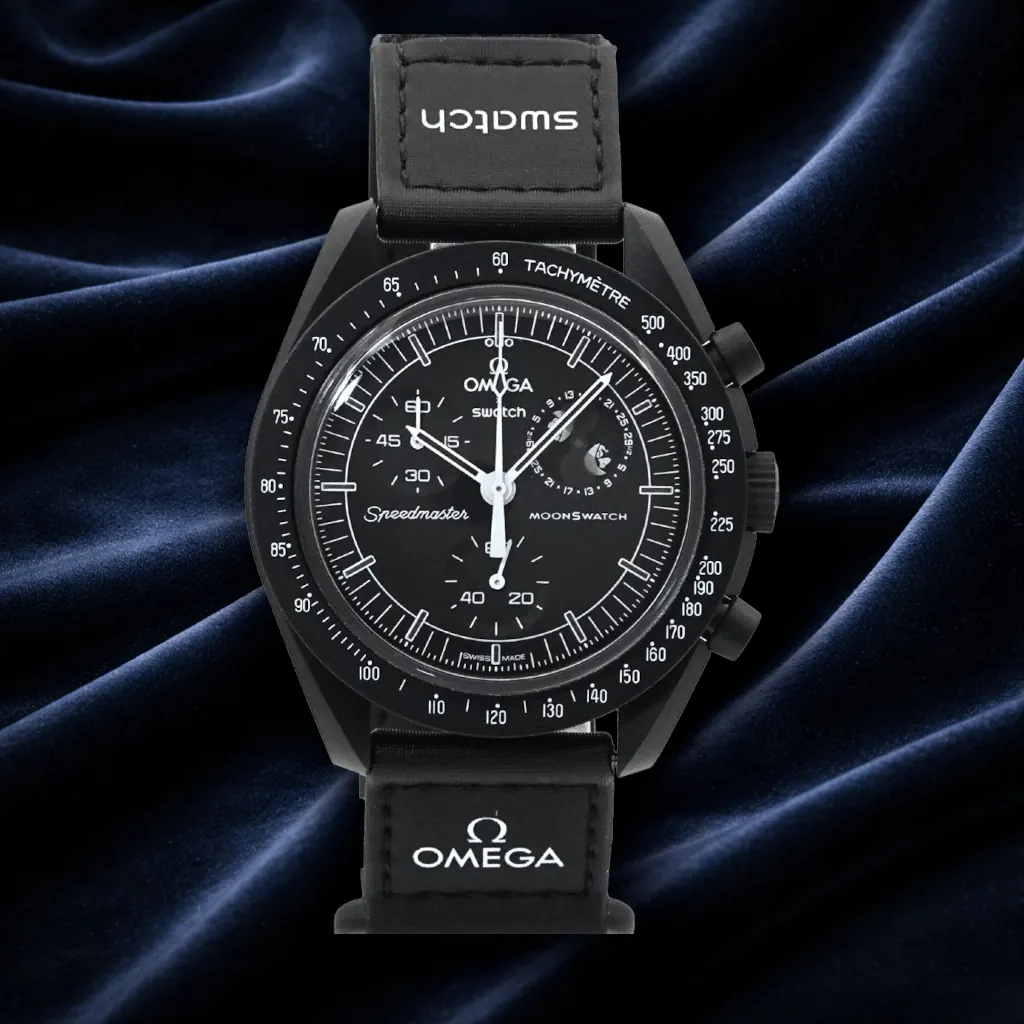
The media’s conflation of “Moon” watches and the search trend for “Swatch Artemis 2” is a misdiagnosis. The real story is the community’s desire to participate in history using the horological token they own. The MoonSwatch became the people’s tribute watch.
Contextualizing the Trend: A Market in Orbit
What does this mean for the market?
- Vintage X-33 Gen 2 Demand: Watch for a spike in interest and value for the specific, NASA-issued reference (3291.50.00). It is now the actual Artemis II watch.
- Breitling Cosmonaute Appeal: The “Astronaut’s Choice” narrative will bolster the desirability of the Cosmonaute among collectors who value provenance and pilot heritage.
- MoonSwatch Sustenance: The trend reinforces the MoonSwatch’s role as a gateway drug to horology and space history, keeping the collection relevant years after its launch.
- The Mechanical Moonwatch Endures: The standard Omega Speedmaster Professional remains the timeless symbol. Artemis II proves it’s now the ceremonial spacewatch, while the X-33 is the working spacewatch.
Sarah’s Workbench: Collector Pro Tip
If you’re hunting a Gen 2 X-33, check the caseback engraving. NASA-issued examples from earlier programs (like ISS Expedition) often have specific mission insignias. An unengraved example is more likely from general military issue. Both have heritage, but the NASA-engraved pieces carry a significant premium and provenance.
Conclusion: A New Chronology for a New Era
The Artemis II watch phenomenon reveals a new, multi-layered horological reality. At the top sits the purpose-built instrument, a digital marvel of pragmatism (X-33). Alongside it flies the personal mechanical companion, chosen for legacy and preference (Cosmonaute, Mechanical Speedmaster). And back on Earth, vibrating through the very foundations of watch culture, is the accessible symbol that allows millions to feel connected (MoonSwatch).
We are no longer in the era of a single watch on the Moon. We are in the era of the ecosystem of space-time. The engineering is more complex, the choices more personal, and the community more involved than ever before. The next giant leap for watchkind isn't a single timepiece; it's this entire, interconnected story unfolding on our wrists and in our forums.
Related Reading
- The First Watch on the Moon: Omega Speedmaster's Historic Journey – The original story that started it all.
- Mastering Chronometry: Top Timekeeping Complications Explained – Understand the engineering behind advanced watch functions.
- From Pulsar to Digital: The History of the First Digital Watch – Explore the evolution of digital timekeeping that led to watches like the X-33.
- Omega Watch Series: A Complete Guide to the Collections – Contextualize the X-33 within Omega's broader lineup.
- Watch Accuracy Compared: How Different Movements Measure Up – A deep dive into what makes a watch keep precise time.