Rolex Datejust: Everyday Luxury With Historical Weight

Vintage watch restoration and historical research
The Rolex Datejust is one of the most enduring watches ever produced — not through excess, but through balance. This in-depth guide explores its origins, design language, technical evolution, size options, and enduring appeal, offering insight for enthusiasts, collectors, and buyers alike.

A Watch That Defined Everyday Luxury
Few watches occupy the cultural space the Rolex Datejust does. It is neither a pure tool watch nor a fragile dress piece, neither ostentatious nor anonymous. For nearly eight decades, the Datejust has quietly defined what an everyday luxury watch can be — dependable, recognizable, and adaptable to almost any context. For some, it is the first serious Swiss watch; for others, a lifelong companion worn alongside far more complicated pieces.
What makes the Datejust especially interesting is not a single breakthrough or headline-grabbing complication, but its cumulative influence. Many of the elements people now associate instinctively with Rolex — the instantly legible date, the Cyclops lens, the fluted bezel paired with a Jubilee bracelet — were either introduced or perfected through the Datejust. Over time, these features became so familiar that they faded into the background of watchmaking, even though they once represented genuine technical and ergonomic progress.
Unlike the Submariner or Daytona, the Datejust was never designed for a specific profession or extreme environment. Its purpose was simpler and, in many ways, more ambitious: to be worn every day, by anyone, anywhere. That neutrality is precisely why it has endured. The Datejust adapts to changing tastes without chasing them, evolving gradually while remaining unmistakably itself.
To understand why the Datejust continues to resonate with both modern buyers and seasoned collectors, it helps to go back to its origins — not as an icon, but as a technical statement.
The Origins of the Datejust
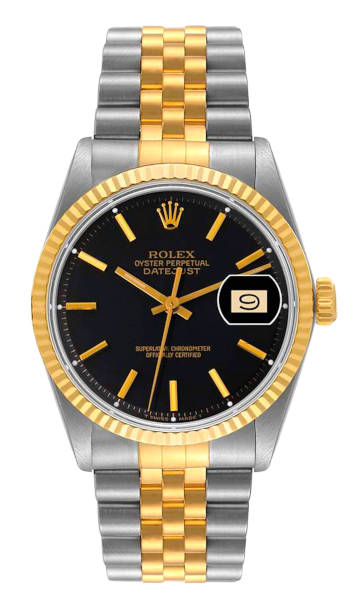
1945: The First Automatic Date at Midnight
The Rolex Datejust was introduced in 1945 to mark the brand’s 40th anniversary. At first glance, it appeared conservative: a 36 mm Oyster case, automatic movement, and a clean dial layout. Yet hidden beneath this restrained exterior was a technical milestone that set it apart from virtually everything else on the market.
The Datejust was the first self-winding wristwatch to display the date through an aperture that changed automatically at midnight. Today, that functionality feels trivial. In the mid-20th century, it was anything but. Date displays existed, but they often required manual adjustment and lacked precision. Rolex’s solution integrated the date mechanism directly into the movement, ensuring reliability and consistency — a hallmark that would come to define the brand’s engineering philosophy.
This emphasis on practicality was intentional. Post-war consumers were not looking for experimental design; they wanted progress they could trust. The Datejust delivered innovation in a form that felt reassuring rather than radical.
The Oyster Case as a Foundation
Equally important was the use of the Oyster case, a design Rolex had been refining since the late 1920s. By the time the Datejust appeared, the Oyster case had already proven its value in terms of water resistance and durability. Incorporating it into a daily-wear watch reinforced the idea that elegance and robustness did not need to be mutually exclusive.
This combination — automatic winding, instantaneous date change, and a sealed case — made the Datejust unusually versatile for its era. It could be worn in professional settings, during travel, and in everyday life without special care. That versatility would become central to its long-term appeal.
The Birth of the Cyclops Lens
In the early 1950s, Rolex added what would become one of its most polarizing design elements: the Cyclops lens. Positioned above the date window, the magnifying bubble increased legibility significantly, especially as dial apertures remained relatively small.
From a purely functional standpoint, the Cyclops made sense. From an aesthetic standpoint, it permanently altered the watch’s visual identity. Love it or hate it, the Cyclops turned the Datejust into something instantly recognizable across a room — a rare achievement in watch design.
Over time, the Cyclops became more than a tool. It evolved into a brand signature, appearing on countless Rolex models and reinforcing the Datejust’s role as a template for the broader collection.
Early Design DNA That Still Endures
What is striking when examining early Datejust references is how little the core formula has changed. The proportions, the balanced dial, the emphasis on legibility — all remain intact. Rolex resisted the temptation to reinvent the watch dramatically, opting instead for incremental refinement.
This continuity is not accidental. The Datejust was never meant to shock or provoke. Its success lies in its familiarity, in the sense that it always feels appropriate. That design restraint, established in the 1940s and 1950s, continues to guide the modern Datejust — a watch that carries its history quietly, without nostalgia or excess.
Design Language: Understated but Instantly Recognizable
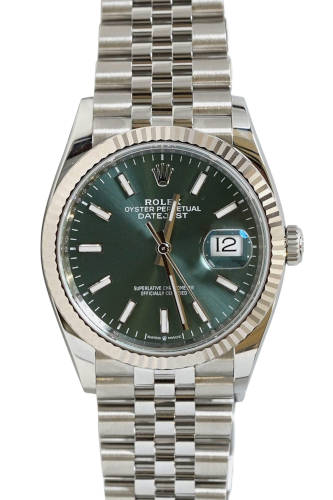
The design of the Rolex Datejust is deceptively simple. At a glance, it appears almost conservative — a round case, a clean dial, and a familiar bezel. Yet this restraint is precisely what gives the Datejust its strength. Over decades, Rolex has refined a visual language that is instantly identifiable without relying on overt branding or exaggerated proportions.
Case, Bezel, and Proportions
The Datejust’s case design is a study in balance. Neither overly thin nor aggressively sporty, it sits comfortably on the wrist in a way that feels intentional rather than trendy. The classic 36 mm size, long considered the standard, exemplifies this philosophy. It wears flatter and more compact than many modern watches, allowing it to transition effortlessly between formal and casual settings.
Bezel choice plays a surprisingly large role in shaping the character of the watch. The fluted bezel, originally developed to screw securely onto the Oyster case, has become synonymous with the Datejust. Its sharp, reflective facets catch the light in a way that adds visual depth without excessive flash. While often associated with white gold or Rolesor models, the fluted bezel also serves as a subtle signal of Rolex’s traditional craftsmanship.
In contrast, the smooth bezel presents a more restrained, contemporary profile. It downplays ornamentation and emphasizes the watch’s versatility, making it particularly popular among buyers seeking an understated daily companion. The difference between the two is not merely aesthetic; it changes how the watch is perceived — ceremonial versus discreet, classic versus modern.
Dial Variations: Conservative Roots, Quiet Experimentation
If the case defines the Datejust’s silhouette, the dial defines its personality. Over the years, Rolex has produced an astonishing range of dial configurations, from austere monochrome designs to more expressive textures and colors. Stick indices remain the most common, offering clarity and symmetry, while Roman numerals add a distinctly traditional, almost architectural feel.
Certain dial variations have developed a following among collectors, not because they are loud, but because they age particularly well. Linen dials, for example, introduce texture without sacrificing legibility. Sunburst finishes, now a staple of modern Datejusts, create subtle shifts in tone depending on light conditions, adding dimension without distraction.
Despite this variety, Rolex has always exercised restraint. Even the more adventurous Datejust dials rarely feel experimental for their own sake. This consistency ensures that the watch remains timeless rather than anchored to a specific era.
The Date Window as a Design Anchor
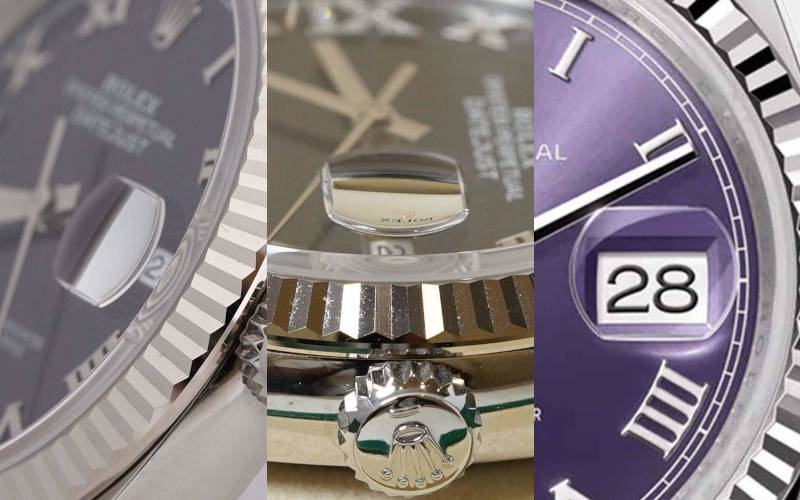
The date aperture at three o’clock does more than provide information; it anchors the entire dial composition. The Cyclops lens, while divisive, enhances usability and reinforces the Datejust’s functional roots. Unlike many watches where the date feels like an afterthought, here it is central to the identity of the piece.
Importantly, Rolex has resisted the temptation to relocate or redesign the date window in pursuit of novelty. Its permanence is part of the watch’s visual stability — a small but meaningful detail that contributes to the Datejust’s sense of continuity.
Why the Design Endures
The enduring appeal of the Datejust’s design lies in its refusal to chase extremes. It does not rely on skeletonization, oversized markers, or aggressive case shapes to assert relevance. Instead, it communicates confidence through familiarity. This is a watch that does not demand attention, yet commands respect from those who recognize it.
In an industry often driven by reinvention, the Datejust’s consistency is a statement in itself. It suggests that good design, once established, does not need constant justification — only careful stewardship.
Technical Foundations
While the Datejust is often discussed in aesthetic terms, its technical evolution is equally important to its longevity. Rolex’s approach to engineering has always favored incremental improvement over radical redesign, and the Datejust serves as a clear example of this philosophy.
Movements: From Caliber 1575 to 3235
Early Datejust models were powered by robust automatic movements that prioritized reliability over complexity. The caliber 1575, introduced in the mid-20th century, became a cornerstone of the collection, known for its durability and ease of service. It established a reputation for accuracy that helped solidify Rolex’s standing as a maker of dependable everyday watches.
Modern Datejust models are equipped with the caliber 3235, a movement that reflects decades of refinement rather than a single leap forward. Featuring Rolex’s Chronergy escapement, increased power reserve, and enhanced efficiency, the 3235 maintains the brand’s focus on precision and longevity. It is designed to perform consistently over long intervals, aligning with the Datejust’s role as a watch meant to be worn daily.
Precision and Certification
Every contemporary Datejust is certified as a Superlative Chronometer, a designation that goes beyond standard chronometer testing. This reflects Rolex’s insistence on controlling the entire production process, from movement assembly to final casing. While such certifications may seem abstract, they translate into tangible benefits: stable timekeeping, reduced maintenance concerns, and long-term reliability.
Oyster Case and Everyday Durability
The Oyster case remains a defining feature of the Datejust’s technical identity. With water resistance typically rated to 100 meters, it offers a level of protection that exceeds what most owners will ever require. This durability reinforces the watch’s versatility, allowing it to move seamlessly between environments without hesitation.
Unlike watches that must be handled delicately, the Datejust invites regular use. Its technical foundations support its design philosophy: elegance without fragility, refinement without compromise.
Datejust Sizes Explained
Few aspects of the modern Rolex Datejust generate as much discussion as case size. While the watch has always been associated with balanced proportions, evolving wrist preferences and broader industry trends have introduced meaningful variation. Understanding these sizes is essential, not only for comfort, but for appreciating how subtle dimensional changes affect the watch’s character.
Datejust 36: The Historical Default
For decades, 36 mm was not considered “classic” — it was simply normal. This size defined the Datejust from its introduction and remained the standard for generations. On the wrist, the Datejust 36 feels composed and intentional, with a dial opening that prioritizes balance over visual dominance.
Collectors often gravitate toward this size for precisely that reason. It reflects the original design intent and maintains a direct visual connection to vintage references. The proportions allow the bezel, dial, and bracelet to coexist without any single element overpowering the others. As trends shift away from oversized watches, the 36 mm Datejust increasingly feels contemporary again, rather than retro.
Importantly, the Datejust 36 wears differently depending on configuration. A fluted bezel and Jubilee bracelet introduce visual complexity that compensates for the smaller diameter, while a smooth bezel and Oyster bracelet emphasize restraint. In both cases, the watch remains versatile, capable of pairing with formal attire or casual clothing without friction.
Datejust 41: Modern Presence, Subtle Adjustments
The introduction of the Datejust 41 responded to changing expectations around wrist presence. While the name suggests a simple scaling up, the 41 mm model incorporates nuanced design adjustments to preserve balance. The case proportions, lug geometry, and dial layout were refined to avoid the bloated appearance that often plagues enlarged designs.
On the wrist, the Datejust 41 offers greater legibility and a more contemporary feel, particularly appealing to buyers accustomed to sports watches. The increased dial space allows certain elements — such as baton indices and sunburst finishes — to breathe more easily, enhancing visual clarity.
That said, the difference between 36 and 41 is not merely numerical. The 41 mm version feels more assertive, even in conservative configurations. This can be an advantage or a drawback, depending on personal preference. Those seeking an understated daily companion may still find the 36 mm more harmonious, while those wanting a single watch that leans slightly modern may prefer the 41.
How Size Influences Identity
Size shapes perception. The Datejust 36 often reads as timeless and discreet, while the 41 communicates confidence and modernity. Neither is objectively better; they serve different sensibilities. What matters is how the watch integrates into the wearer’s lifestyle and existing collection.
For first-time buyers, trying both sizes is invaluable. The difference in feel is immediate and cannot be fully captured on paper. For collectors, the choice often reflects philosophy: historical continuity versus contemporary adaptation.
Bracelet and Material Choices
Beyond size, the Datejust’s versatility is defined by its bracelet and material options. These choices can transform the watch from reserved to expressive, from purely utilitarian to subtly luxurious.
Jubilee vs Oyster: Comfort and Character
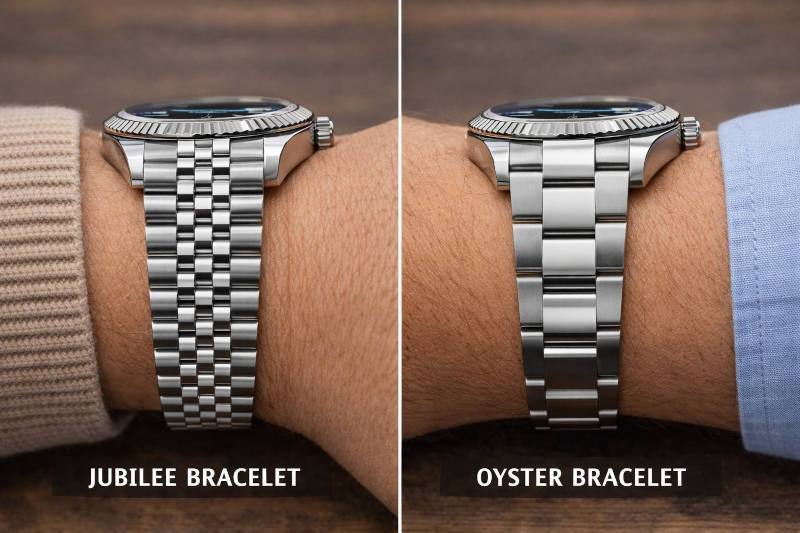
The Jubilee bracelet, introduced alongside the Datejust in 1945, remains one of the collection’s most distinctive features. Its five-link construction offers exceptional comfort, conforming naturally to the wrist. Visually, it adds refinement and movement, especially when paired with a fluted bezel.
The Oyster bracelet, by contrast, emphasizes solidity and simplicity. Its three-link design feels sportier and more grounded, lending the Datejust a slightly more utilitarian edge. For those who view the Datejust as a daily tool rather than a statement piece, the Oyster bracelet often feels like the natural choice.
Both bracelets benefit from Rolex’s modern clasp systems, which improve security and ease of adjustment. While the differences may seem subtle, they significantly influence how the watch is experienced day to day.
Oystersteel, Rolesor, and Precious Metals
Material selection further shapes the Datejust’s identity. Oystersteel models represent the most understated expression of the watch, prioritizing durability and neutrality. They are often favored by buyers seeking longevity over display.
Rolesor — Rolex’s combination of steel and gold — introduces contrast without excess. Yellow gold adds warmth and tradition, while Everose gold offers a softer, contemporary tone. Full precious metal models, though less common, elevate the Datejust into a more overtly luxurious category, appealing to those who appreciate the watch as both a functional object and a symbol.
Each material choice alters how the Datejust interacts with light, clothing, and context. This adaptability is central to the collection’s appeal, allowing the same fundamental design to speak in different voices.
Collector Perspective
While the Rolex Datejust is often discussed as an accessible entry point into the brand, its collector significance is frequently underestimated. Beneath its familiar exterior lies a depth of variation that rewards close attention, particularly for those willing to look beyond headline references and current production models.
Vintage vs Modern Datejust
Vintage Datejusts offer something modern iterations cannot fully replicate: a tangible connection to Rolex’s mid-century identity. Acrylic crystals, thinner cases, and pie-pan dials introduce warmth and character that develop over time. These watches often wear smaller and lighter, creating a distinct wrist experience that appeals to collectors who value subtlety over presence.
Patina plays an important role here. Tritium lume that has aged evenly, dials that have softened in tone, and bracelets showing honest wear all contribute to a sense of authenticity. For some collectors, these imperfections are not flaws but evidence of a life lived.
Modern Datejusts, by contrast, excel in precision and durability. Sapphire crystals, improved water resistance, and contemporary movements make them easier to live with daily. The fit and finish are undeniably superior, and the consistency of modern manufacturing ensures predictable performance. The choice between vintage and modern is less about quality and more about philosophy: character versus convenience.
Overlooked References Worth Attention
Certain Datejust references remain undervalued relative to their historical or aesthetic significance. Engine-turned bezels, for example, occupy a space between smooth and fluted, offering texture without formality. Similarly, specific dial variants — such as early silver sunburst or uncommon numeral layouts — provide individuality without straying into novelty.
Two-tone models from earlier decades are also gaining renewed interest. Once dismissed as dated, they are now being re-evaluated through a contemporary lens, appreciated for their confidence and unmistakable period identity.
The Datejust as a Long-Term Companion
Collectors often describe the Datejust not as a centerpiece, but as a constant. It is the watch worn when others are rotated out, the one that remains relevant regardless of trends. This quiet reliability is perhaps its greatest strength. The Datejust does not demand admiration; it earns it gradually, through consistency and familiarity.
Buying a Rolex Datejust Today
| Store | Link |
|---|---|
| Ebay | Check it out on Ebay |
| The Luxury Closet | Check it out on The Luxury Closet |
For buyers entering the Datejust market, the abundance of options can feel overwhelming. Yet this variety is also a strength, allowing for a high degree of personalization.
New vs Pre-Owned
Purchasing new offers peace of mind and the assurance of factory condition, but availability can be unpredictable. Many buyers turn to the pre-owned market, where selection is broader and wait times are eliminated. Pre-owned Datejusts also offer access to discontinued configurations that may better align with personal taste.
From a value perspective, the Datejust has historically demonstrated strong retention. While it should not be viewed as a speculative asset, its stability makes it a relatively safe choice for those concerned with long-term ownership.
What to Check Before Buying
Condition is paramount. Bracelet stretch, dial originality, and service history all deserve close scrutiny. A well-preserved Datejust with documented maintenance will provide a better ownership experience than a cosmetically altered example.
Authenticity should never be assumed. Reputable marketplaces and sellers reduce risk, but due diligence remains essential. Understanding reference numbers and period-correct components can make the difference between a satisfying purchase and a costly mistake.
Trusted Marketplaces
Platforms such as The Luxury Closet have become viable sources for pre-owned Rolex watches, provided buyers engage thoughtfully and prioritize condition, documentation, and seller transparency. Detailed listings, transparent return policies, and seller reputation are key indicators of reliability. When approached carefully, this type of platform offers access to a curated global inventory that would be difficult to replicate locally.
Why the Datejust Endures
The Rolex Datejust endures because it avoids extremes. It is neither nostalgic nor futuristic, neither purely functional nor overtly decorative. Instead, it occupies a middle ground that few watches manage to sustain over decades.
Its strength lies in its adaptability — to changing tastes, evolving technology, and shifting cultural contexts. The Datejust does not attempt to redefine luxury; it quietly exemplifies it. In doing so, it remains one of the most relevant watches Rolex has ever produced, not because it demands attention, but because it deserves it.