Oil-Filled Watches Explained: Why Some Watches Are Liquid Inside

Mechanical movements and watch engineering
Oil-filled watches replace air inside the case with liquid to improve legibility and pressure resistance. This in-depth guide explains how the technology works, why it exists, and who it’s really for.
- Introduction
- What Is an Oil-Filled Watch?
- Why Does This Concept Exist at All?
- How Oil-Filled Watches Work (Technically, Without the Math)
- Why Use Oil Instead of Air? Benefits and Trade-Offs
- Real-World Examples: How Brands Implement Oil-Filled Technology
- Oil-Filled vs Traditional Watches: A Practical Comparison
- Who Oil-Filled Watches Are (and Are Not) For
Introduction
At first glance, an oil-filled watch sounds like a mistake rather than a design choice. Watches are supposed to keep liquids out, not deliberately trap them inside. Yet a small group of highly technical timepieces does exactly that—replacing the air inside the case with oil.
This is not a gimmick, nor a recent experiment. Oil-filled watches exist to solve very specific physical problems that traditional watchmaking struggles with, particularly underwater legibility and pressure resistance. They are rare, unusual, and often misunderstood—even among seasoned watch enthusiasts.
To understand why these watches exist, you need to momentarily forget marketing narratives and think like an engineer.
What Is an Oil-Filled Watch?
An oil-filled watch is a watch whose case interior—usually the space between the dial and the crystal—is completely filled with a transparent, specially engineered liquid instead of air.
This oil is:
- Optically clear
- Non-conductive
- Chemically stable
- Resistant to temperature changes
The movement itself may be partially isolated or fully immersed, depending on the design. In many modern examples, only the display module is oil-filled, while the mechanical or electronic movement sits in a sealed, dry compartment.
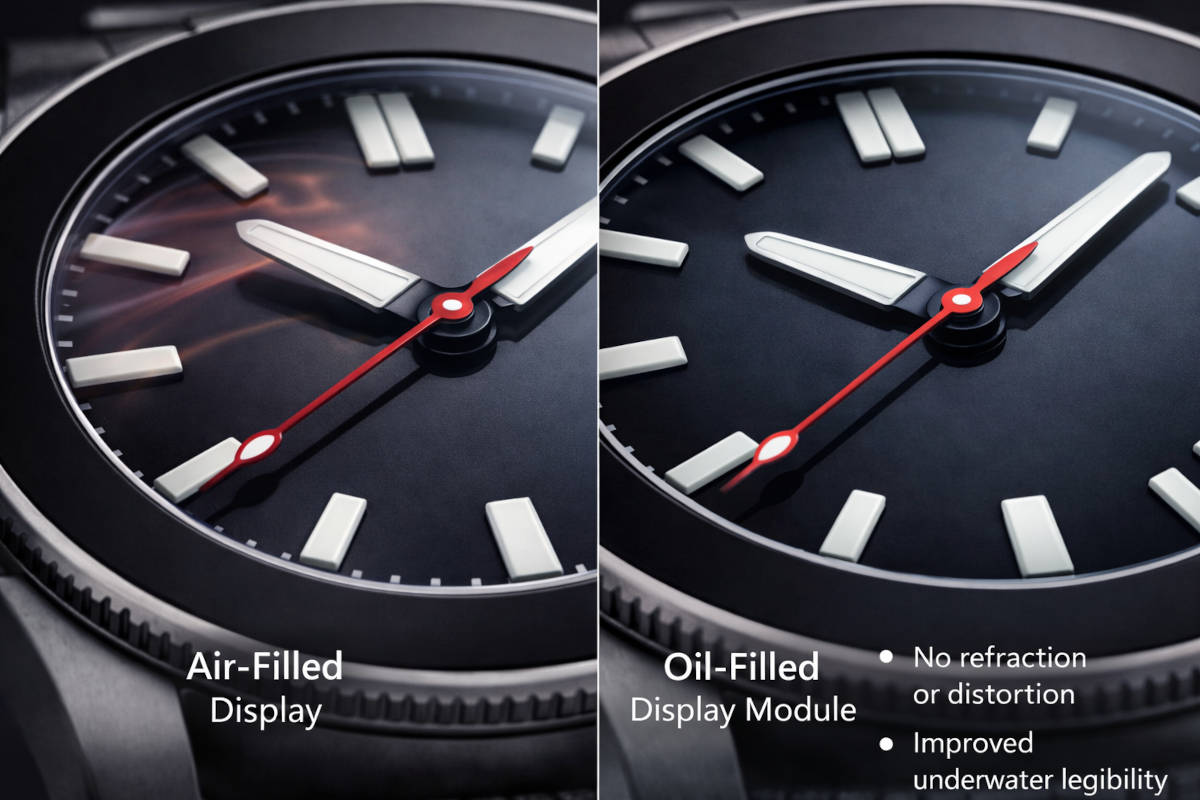
From the outside, these watches often look almost unreal. The dial appears to be painted directly onto the crystal, with no visible depth. Hands seem to float. Reflections nearly disappear.
That visual effect is not the goal—it is a consequence.
Why Does This Concept Exist at All?
The idea of filling a watch with oil was not born from aesthetics. It emerged from a fundamental limitation of traditional dive watches.
Underwater, visibility is everything. At depth, light scatters differently, and reflections on the inside of a watch crystal can severely reduce legibility. At the same time, water pressure increases dramatically, placing enormous stress on the crystal and case.
Air inside a watch becomes a liability:
- It creates reflective surfaces
- It compresses unevenly under pressure
- It forces manufacturers to use extremely thick crystals
Oil, on the other hand, behaves very differently.
Liquids are nearly incompressible. By filling the internal space with oil, pressure inside the watch equalizes with the external water pressure. This drastically reduces mechanical stress on the crystal and allows for slimmer constructions—even at extreme depths.
In short, oil-filled watches exist because:
- Air is optically and mechanically inefficient underwater
- Oil solves both problems at once
The concept is niche because the problem it solves is niche. But where it applies, it works exceptionally well.
How Oil-Filled Watches Work (Technically, Without the Math)
To understand oil-filled watches, it helps to think in terms of physics rather than watchmaking tradition. The key principle at work is refractive index—the way light bends as it passes through different materials.
Air and sapphire have very different refractive indexes. When light moves from water → sapphire → air → dial, it bends at each boundary. Underwater, this causes glare, internal reflections, and a loss of contrast. The deeper you go, the worse it becomes.
Oil changes that equation.
Optical Coupling: Why the Dial Looks “Painted on the Glass”
The oil used inside these watches has a refractive index very close to that of sapphire crystal. When oil fills the space between the dial and the crystal, light no longer bends sharply at that boundary.
The result:
- Virtually no internal reflections
- Extremely high contrast
- Perfect legibility from any angle
This is why oil-filled watches look almost digital in clarity, even when they are fully analog. The dial appears to sit directly on the underside of the crystal because, optically speaking, the space between them almost disappears.
This is not a stylistic trick—it is a direct consequence of removing air from the system.
Pressure Equalization: Oil vs. Air Underwater
Pressure increases by roughly 1 bar every 10 meters underwater. In a traditional watch, the air inside the case resists this pressure. That resistance transfers stress to the crystal and gaskets.
Oil behaves differently:
- It does not compress meaningfully
- It transmits pressure evenly in all directions
By filling the internal volume with oil, internal pressure rises in sync with external pressure. The crystal is no longer fighting against a pressure differential—it is effectively supported from both sides.
This allows oil-filled watches to:
- Reach extreme depth ratings
- Use thinner crystals than comparable air-filled watches
- Reduce the risk of crystal deformation
In practical terms, this is why watches like the Sinn UX can be rated to depths that would normally require absurdly thick sapphire.
What Happens to the Movement?
This is where oil-filled watches become technically interesting—and complicated.
Mechanical movements rely on air for:
- Regulating balance wheel oscillation
- Lubricant behavior
- Thermal stability
Immersing a mechanical movement fully in oil would dramatically alter its timekeeping behavior. For this reason, most oil-filled watches either:
- Use quartz movements (more tolerant of oil)
- Isolate the mechanical movement in a dry capsule
Some watches blur that line in clever ways, but none of them ignore it. Oil-filled design always forces trade-offs elsewhere.
We will look at real-world solutions—and their consequences—in the next section.
Why Use Oil Instead of Air? Benefits and Trade-Offs
Oil-filled watches are not “better” than traditional watches in a general sense. They are better at very specific things, and worse at others. Understanding this balance is essential—especially for buyers drawn in by the unusual look.
The Key Advantages of Oil-Filled Watches
1. Unmatched Underwater Legibility
This is the primary reason oil-filled watches exist.
Because internal reflections are almost completely eliminated, the dial remains readable:
- At extreme angles
- In low light
- Underwater, even at depth
Compared side by side with a traditional dive watch, the difference is immediately obvious. The oil-filled watch looks calm and flat; the air-filled watch shows glare, distortion, and depth.
This is not subjective—it is optical physics at work.
2. Extreme Pressure Resistance Without Bulk
Traditional dive watches fight pressure with thickness:
- Thicker sapphire
- Heavier cases
- Reinforced gaskets
Oil-filled watches fight pressure with equalization.
Because pressure is transmitted through the oil instead of resisted by trapped air, these watches can achieve:
- Very high depth ratings
- Reduced mechanical stress
- Slimmer profiles relative to their rating
This is why some oil-filled watches are certified for depths far beyond human diving limits, without looking like industrial tools.
3. Thermal Stability at Depth
Temperature changes can cause air to expand or contract, affecting internal pressure and gasket performance.
Oil reacts more slowly to temperature shifts and distributes thermal changes evenly. This improves:
- Sealing consistency
- Crystal stability
- Long-term reliability in extreme environments
Again, this matters only in edge cases—but oil-filled watches are built specifically for those edge cases.
The Limitations and Compromises
1. Service Complexity
Oil-filled watches are harder to service than conventional watches.
Opening the case is not a simple operation:
- Oil must be removed and replaced
- Air bubbles must be eliminated
- Sealing must be perfect
As a result:
- Fewer service centers can work on them
- Service costs are typically higher
- Turnaround times can be longer
This is not a deal-breaker, but it is a reality owners must accept.
2. Temperature Sensitivity Above Water
While oil helps at depth, it introduces challenges on land.
Oil expands when heated. In hot environments, this can cause:
- Slight case deformation
- Temporary changes in crown feel
- The need for flexible compensation systems inside the case
Well-designed oil-filled watches account for this, but it adds complexity and limits how thin or minimalist the case can be.
3. Movement Limitations
As mentioned earlier, oil and mechanical movements are not natural friends.
Most oil-filled watches:
- Use quartz movements for reliability
- Separate the movement from the oil-filled display
This can disappoint purists who equate horological value with traditional mechanics. Oil-filled watches prioritize function over tradition.
Oil-filled watches are not about improving watchmaking across the board. They are about solving a narrow problem exceptionally well—and accepting the compromises that come with that solution.
Next, we’ll look at how these principles are applied in real, production watches you can actually buy.
Real-World Examples: How Brands Implement Oil-Filled Technology
Oil-filled watches are rare, but they are not theoretical. A small number of manufacturers have committed to the concept and refined it over years of practical use. Each has approached the problem differently, based on its technical priorities and brand philosophy.
These examples are not interchangeable—they illustrate distinct interpretations of the same core idea.
Sinn UX: Function First, No Apologies

Sinn’s UX series is often the reference point for oil-filled dive watches.
Originally developed for German special forces divers, the UX is built around a simple premise: absolute legibility and extreme pressure resistance matter more than tradition or decoration.
Key characteristics:
- Fully oil-filled case
- High-accuracy quartz movement
- Exceptional depth rating far beyond recreational diving
- Dial that appears perfectly flat under all conditions
The UX does not attempt to hide its utilitarian nature. The oil filling is a tool, not a feature to be admired. Everything about the watch supports that mindset.
| Store | Link |
|---|---|
| Ebay | Check it out on Ebay |
Bell & Ross Hydromax: Maximum Depth as a Statement
The Hydromax took oil filling to its logical extreme.
Bell & Ross filled the entire case—including the movement—with oil, creating a watch rated to depths few humans will ever experience. The goal was not practicality but proof of concept: how far can this idea be pushed?
What makes the Hydromax notable:
- Entire case oil-filled
- Minimal internal air volume
- Extreme depth rating used as a technical showcase
This approach introduced serious engineering challenges, including timekeeping regulation and thermal expansion management. As a result, the Hydromax remains more of a technical milestone than a daily-wear watch.
It serves as a reminder that oil-filled design is not a single solution, but a spectrum of compromises.
Ressence Type 3: Oil Filling as an Optical Tool
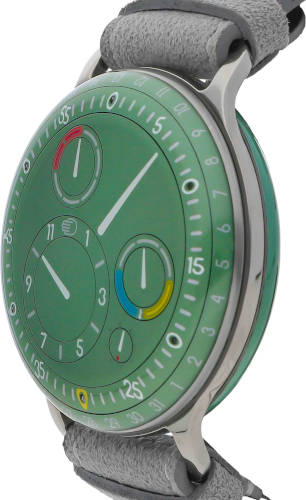
Ressence took oil-filled technology in a completely different direction.
The Type 3 is not a dive watch in the traditional sense. Instead, it uses oil to solve an optical problem: making a complex mechanical display readable from any angle.
In the Type 3:
- The display module is oil-filled
- The mechanical movement is sealed in a dry chamber
- Rotating discs replace traditional hands
The result is a watch that feels almost screen-like, despite being entirely mechanical. Depth rating is secondary here; clarity and visual calm are the real goals.
| Store | Link |
|---|---|
| Ebay | Check it out on Ebay |
Three Watches, Three Philosophies
What these examples show is that oil-filled watches are not a category defined by looks or price, but by intent.
- Sinn uses oil to solve real-world operational problems
- Bell & Ross used it to explore physical limits
- Ressence uses it to rethink how time is displayed
The technology is the same. The outcomes are radically different.
Next, we’ll compare oil-filled watches directly with traditional air-filled watches—and clarify where each makes sense.
Oil-Filled vs Traditional Watches: A Practical Comparison
Comparing oil-filled watches to traditional air-filled watches is less about superiority and more about suitability. Each approach is optimized for different conditions, and understanding those differences helps cut through the novelty.
Legibility: Where Oil-Filled Watches Clearly Win
In normal indoor conditions, most modern watches are perfectly readable. The difference becomes obvious only when conditions deteriorate.
Oil-filled watches excel when:
- Viewed at sharp angles
- Used underwater
- Exposed to strong directional light
Traditional watches rely on anti-reflective coatings and dial contrast. Oil-filled watches remove the problem at its source by eliminating air altogether.
For anyone who prioritizes instant readability in harsh environments, this is not a subtle improvement—it is transformative.
Depth Rating and Structural Stress
Traditional dive watches resist pressure mechanically. Oil-filled watches neutralize it.
| Aspect | Traditional Watch | Oil-Filled Watch |
|---|---|---|
| Internal medium | Air | Oil |
| Pressure strategy | Resistance | Equalization |
| Crystal thickness | Often very thick | Can be thinner |
| Stress on seals | High at depth | Lower at depth |
This is why oil-filled watches can achieve extreme ratings without appearing oversized. However, those ratings are often academic for everyday wearers.
Daily Wear and Practicality
This is where traditional watches regain ground.
Oil-filled watches may introduce:
- Heavier overall weight due to oil mass
- Limited case designs
- Higher servicing complexity
Traditional watches offer:
- Greater variety of movements and designs
- Easier global servicing
- Fewer temperature-related considerations
For office wear, travel, and general use, a traditional watch is usually the more convenient choice.
Mechanical Romance vs Functional Clarity
Many enthusiasts value mechanical watches for emotional reasons:
- Visible depth
- Moving parts
- Traditional construction
Oil-filled watches feel different. Their dials are optically flat. Hands lack shadow. Some find this sterile; others find it hypnotic.
Neither reaction is wrong. It simply reflects different expectations of what a watch should be.
The Honest Summary
Oil-filled watches are not upgrades to traditional watches. They are alternative solutions built around different priorities.
Choose oil-filled if:
- Legibility is critical
- You appreciate engineering-driven design
- You understand the compromises
Choose traditional if:
- Mechanical tradition matters
- Versatility is important
- You want simple ownership
In the final section, we’ll clarify who should—and who should not—seriously consider buying an oil-filled watch.
Who Oil-Filled Watches Are (and Are Not) For
Oil-filled watches attract curiosity, but curiosity alone is not a good reason to buy one. These watches make sense only when their specific advantages align with the owner’s expectations and use case.
This is where many misunderstandings occur.
Who Should Seriously Consider an Oil-Filled Watch
Professionals and tool-watch users
Divers, engineers, and individuals working in environments where glare, water, or pressure are real constraints—not theoretical ones—benefit most. For them, the technology is functional, not exotic.
Enthusiasts drawn to engineering solutions
If you value watches as instruments first and cultural objects second, oil-filled designs are intellectually satisfying. They represent problem-solving rather than tradition.
Collectors who already own “classic” watches
Oil-filled watches make sense as a second or third watch—something deliberately different. They offer a radically different wearing experience without trying to replace conventional horology.
Who Should Probably Avoid Them
Buyers expecting mechanical romance
If your enjoyment comes from layered dials, visible depth, and traditional hand movement, oil-filled watches may feel emotionally flat—even unsettling.
Those wanting easy, universal servicing
Oil-filled watches require specialized handling. Owners must be comfortable with fewer service options and potentially longer downtimes.
Anyone buying purely for novelty
The unusual look wears off quickly. Without an appreciation for why the technology exists, the watch risks becoming a curiosity rather than a companion.
A Technology with a Clear Purpose
Oil-filled watches are honest. They do not pretend to be all things to all people. When they work, they work exceptionally well. When their strengths are unnecessary, their compromises become more obvious.
They sit at the intersection of physics and horology—quietly solving problems most watches never encounter.
And that, ultimately, is their appeal.